Friday, October 14, 2022

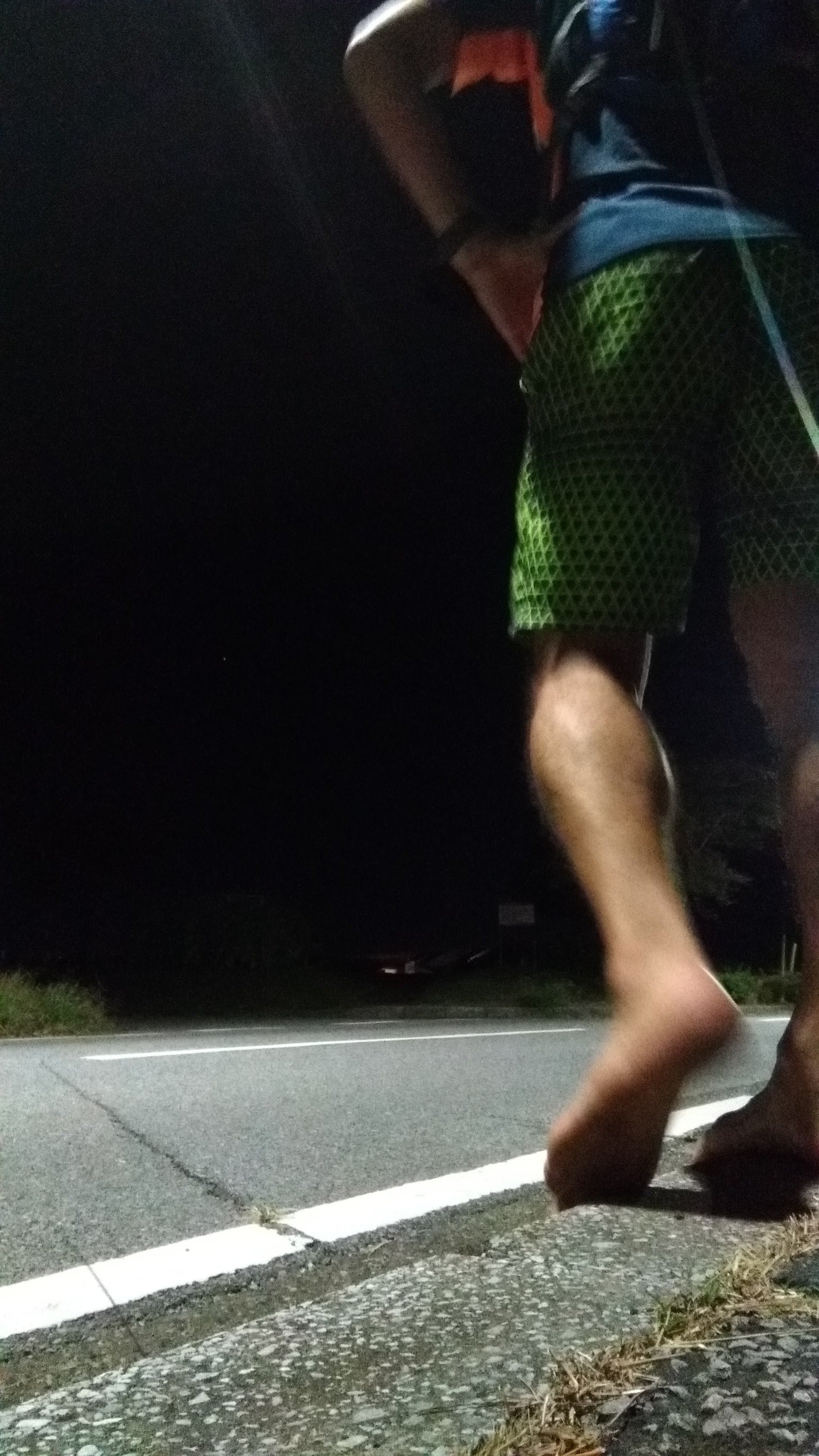
Meniscus Tear Rehab Midnight Barefoot Jog on Grass / 半月板損傷リハビリ芝生裸足走

Oct. 14, 2022

It was originally cycling day. But I canceled it and made it run day. For a couple of reasons. One, I was bushed from a late-night lecture. Two, I had an early start on the following morning. A quick run, I thought, was better. 

What I like about running is its simplicity. You throw yourself into running gear, and off you go. No maintenance costs whatsoever for mechanical gear. Shoe-clad runner will have to buy shoes every once in a while. And shoes these days are quite dear. But barefoot runners have no need to do that. All you need is yourself, shorts, and a shirt. 

The midnight grass of the park was wet and pleasantly cold on the sole. It buffers landing impact, unlike asphalt roads. The park was deserted, except that there was a lonely man cuddling his dog. It was whining in his arms. It sounded as if knowing its owner's loneliness and sharing his pain. 

Because I called it a day before feeling exhausted, I had a good night's sleep and woke up afresh the following morning. 


Tuesday, October 4, 2022

Meniscus Tear Rehab Midnight Barefoot Jog

Oct. 04, 2022

I hit a nearby park after coming home from work past midnight. I ran there in bare feet. I love running a deserted park. Not a single soul was around. There were only crickets chirping in the bush. Those sounds of nature soothe my mind after hours of hard work.

I didn't listen to audio today. I wanted to talk to myself inside. That quiet inner talk is precious at the end of the day. I can review the day's work and preview what I need to do on the following day.


I also thought about my American friend who is a Marine. The following day was his last day in Japan. His service was short-term. But he says he enjoyed his time here, and that someday he wants to return for a longer service. I look forward to it. I met him twice when he visited Tokyo. He is so much fun to be around with. On his second visit, he brought around his buddies. They were fun to be around too. Wild! But fun nonetheless. 


Ever since I signed up for the Ohme 30 K Road Race next February, one-hour jog has been a staple of my weekly training. I don't run as often as I used to because the injured left knee longer time for recovery. But I have learned how to stay fit without running as frequently as before. I compensate my lower running frequency with cycling and body weight workout. I'm still trying to figure out what's best for me. But the whole process is enjoyable. As Confucious said, "If you love what you do, you will never work another day in your life."


Wednesday, September 28, 2022

Meniscus Tear Rehab Midnight Barefoot Jog on Grass / 半月板損傷リハビリ芝生裸足走

Sept. 28, 2022

I love working out after work. I know for some people evening is time for relaxation. I can totally relate to that. It's only that I get off work at 10 p.m., and because of the nature of my work, which is teaching, it is not easy to immediately hit the bed after work. My mind is racing quite a bit. It takes a couple of hours for it to calm down. 

There are different ways to achieve the goal of calming yourself down before going to bed. Some may do breathing. Others read a book till their eyes get heavy. I do both every now and then. But my favorite is going for a jog. That steady rhythm of landing soothes my mind. 
 
But I have a small problem when I run at night. Though I run mainly for relaxing myself, I often listen to audio while running because I want to get the most out of the running time. 


It has both benefits and downsides. One benefit is reinforcing useful information. For example, last night I got to hear a very motivating statement by Marie Forleo that says, "Fail is faithful attempt in learning." Wow! Isn't that awesome? It's immediately applicable to my daily teaching. Many students try something, and end up failing and feeling bad about it. From now on, I can tell them that it is not the end of the world. In fact, it is the start of your ongoing learning journey!!

But once that info. is registered as important, naturally, your brain will stay busy sorting it out for a while after you climb into bed. Naturally, it takes a while for you to fall asleep. In other words, it is against my hope to immediately fall asleep when I go to bed after late night jog.

I'm still wondering what to do with this double bind. I may consolidate all my input effort in the morning while saving my late-night hours strictly for emptying my mind if such a thing ever exists.


Tuesday, September 20, 2022

Meniscus Tear Rehab Midnight Jog

Sept. 19, 2022


Tonight, I was a little indecisive on running. Should I run? Should I wait for a couple of days more? The hesitation was due to a slight iffy feeling that occurred in the morning following my previous session last Thursday. The session was pain-free. But then on the following morning, the left knee seemed swollen just a little, and plus there was this iffy feeling that I had never felt before the injury. 

I avoided running for three days. While skipping running, I tried to stay fit by walking, cycling and body weight training. It worked. Three days later, I felt ready.

When I changed into my running gear and walked several steps, that iffy feeling in my left knee wasn't completely gone. But I started running anyway, saying to myself, "If it hurts, all I need to do is stop running and start walking. "

Pain didn't come. So I kept on running till I thought I had run enough for the night. 

After running, as I took a warm shower, I wondered if that iffy feeling was caused for a structural reason, or by what late Dr. John E. Sarno calls TMS.

If you want to know what TMS is, I suggest reading "Healing Back Pain" in which is explained how pain is induced by ischemia, which is a word meaning local lack of blood. The book explains how this lack of blood occurs not for a structural reason, but by the automatic nervous system as a result of repression of strong emotions such as anger and fear.


Thursday, September 15, 2022

Benefit of Your Ability to Understand English: Access to Updated Medical Informatoin

Aug. 12、2022

One of many great benefits of having the ability to understand English is that you have free access to some of the latest medical articles. If you don't have this ability, you usually need to wait for them to be translated into your own language. That often takes one to two years. Or often times, some are simply not translated at all. While waiting for a translation, by the way, you are only exposed to medical information that has not been updated. 


For example, in the field of knee injuries and their treatment, it is largely taken for granted that your cartilage doesn't regenerate itself once it is damaged. Most medical narratives say that there are no blood vessels running in knee joints (which is true by the way), and they often cite it as if to say that full recovery is beyond hope. 

However, reality shows that athletes who were once tormented with pain as a result of knee injury will often become pain-free after months after months of rehabilitative effort. If fact, I am one of those who once almost lost hope for recovery but who has recovered to a decent level. I jogged for 30 to 40 minutes two days in a row in bare feet on grass, and I went out for a 30 + K bike ride the following night. The following morning there was no iffy feeling in the knee once injured. 

Had I completely accepted the "knee joints won't regenerate because there is no blood stream there" mantra, I would not have recovered this much, because I would have simply abandoned hope for recovery, and settled for a crippled version of myself. 

I did not, however, lose hope. Two videos helped me. I would like to write about them one by one.

In this video physio-therapist Maryke plainly explains the mechanics of meniscus discs and how injuries occur. The most significant take-away from this video to me is that pain eventually calms down fully, and you can function fully even if you continue to have a tear in your meniscus disc. This is a scientifically proven fact. It has also been repeatedly observed in physio-therapeutic practices.

The fact that full functionality can be regained regardless of existence of tear is enough for me to move forward. But just in case you may be so hung up with whether a tear will heal or not, I would like to draw your attention some intriguing medical practice. At orthopedic clinics, they MRI-scan you to diagnose 'a meniscus tear'. However, they almost never MRI-scan you again after pain calms down. So even when you get better, you will never know whether it is because the teared tissued have brought together or not. Why do docs not MR-scan you when pain calms down just to make sure that a tear has been healed? I assume that most likely a tear is often or sometimes still there. But suppose that pain is absent even when the tear remains, a funny question arises: Wasn't the tear the cause of the pain???  I will leave readers to answer the question.

I suggest you stop worrying all together about whether the tear has healed or not. I suggest you accept a structural abnormality such as a tear as simply a typical manifestation of degeneration resulting from ageing and that you live with it!!

Now that you know that you can recover pain-free athletic life whether or not a tear heals, the next step is learning how. While Maryke does show you some specific rehabilitative techniques, and also teaches you the most fundamental lesson that different activities are recommended depending of your recovery stages, her advice is mainly focused on initial stages of recovery. And therefore, for those who want more advanced rehab efforts needed in late stages of recovery, we need to turn to another video.

"Knee Meniscus Tear Test and Exercises for Full Recovery" is a great video.
In this video Eric Wong, an athlete and physio-therapist, gives you two things:
1) Hope
2) What to do for full recovery

Eric had a medial meniscus tear. When he shot the video, he was still in rehab process. He started with an acute pain.  Now the pain is almost gone, and he is able to do things he would never have imagined doing immediately after the injury. That alone is proof enough to make me want to try what he recommends in the video.

He introduces you to some diagnostic tests that everyone can easily do from home in order to identify what type of meniscus tear you have.

He also stresses the importance of knowing your upper limit of motion range of your knee. If you want to steadily recover, it is important to give it just the right amount of stimulus for the recovering connective tissues including the injured meniscus disc so that it can produce recovering response to the stimulus. If the stimulus is too strong, it makes it worse. If it is optimal, it will be stronger without causing pain. Patience and precision are required, it should be noted.

I would like to conclude this short essay by sharing a highly informative medical article. It was written by Duke Health, a world-class academic and health care system. It is entitled "Regrow cartilage in joints? Science says you can".

Long story short, cartilage in human joints can repair itself. The process is similar to that some fish and amphibian use when they regenerate limbs. It could be harnessed to treat osteoarthritis (変形性関節症), a common syndrome seen among the ageing population. 

Virginia Byers Kraus, a senior author of the article and a professor in the departments of Medicine, Pathology and Orthopedic Surgery at Duke, says molecules called microRNAs regulate the process. And she calls this human capacity to repair joint tissues our 'inner salamander' capacity because it is most famously observed in the amphibian. 

Prof. Kraus mentions use of microRNAs as medicines to slow or prevent degeneration of joints in severely suffering patients. Personally, the fact that we have innate capacity to repair our degenerating joints is enough to stay hopeful. I should only be careful not to overdo it. But for those who are in severe pain to the point where simple basic activities are hard to conduct, Prof. Kraus's research should certainly be extremely encouraging.

I would like to conclude this by saying, "Where there is a will and updated medical knowledge, there is a way." 


Meniscus Tear Rehab Midnight 10 K Jog in Minimalist Shoes

Sept. 15, 2022

5.1 K: 31:42.25

5.1 K: 29:51.04

Total 10.2 K: 1:01:33


I hit the road after work. My glutes, hamstrings, and adductors were a bit sore from weighted leg lunges on the previous afternoon, but I guessed that as long as I kept an easy pace, it would not bother me.

In fact, it did bother me slightly at first. But as I kept on running, the initial discomfort gradually became negligible. And about 45 minutes into it, there was a significant rush of some kind of natural pain-killer, be it β-endorphin or dopamine, I felt numb to all sorts of discomfort and soreness, and from that point on, I just kept on going like a locomotive.   


After I got home, I took a quick shower, and had a light meal consisting of tofu, natto, and brown rice. After the meal, as I was writing this blog post, I was engulfed with deep satisfaction. Can't wait to run again....


Monday, September 12, 2022

Midnight Bike Ride

Sept. 12, 2022  


Today is bike day. For me at least. After running 11 K in bare feet two days before, I wanted to give my recovering knee a little more rest. But at the same time, I wanted to stimulate my cardio and also to build my leg strength. Hence, cycling, because it is a much lower-impact activity for the knee.

I chose a course that has many hills and some long straight roads. It allows me to practice hill climbs as well as sprints. 

I took a brief fuel stop at a convenience store near Morita Architects Partnership. I ate an egg sandwich and drank barley tea. It hit the stop after a 10 K + ride with a 700 m uphill near the end.

After filling my stomach, I enjoyed my ride back home in high spirits. I increased cadence on uphills in top gear, and injected the pace on straights in low gear. This way I was able to develp different kinds of strength. 

I hope to do some core training tomorrow night or on the morning of Wednesday.